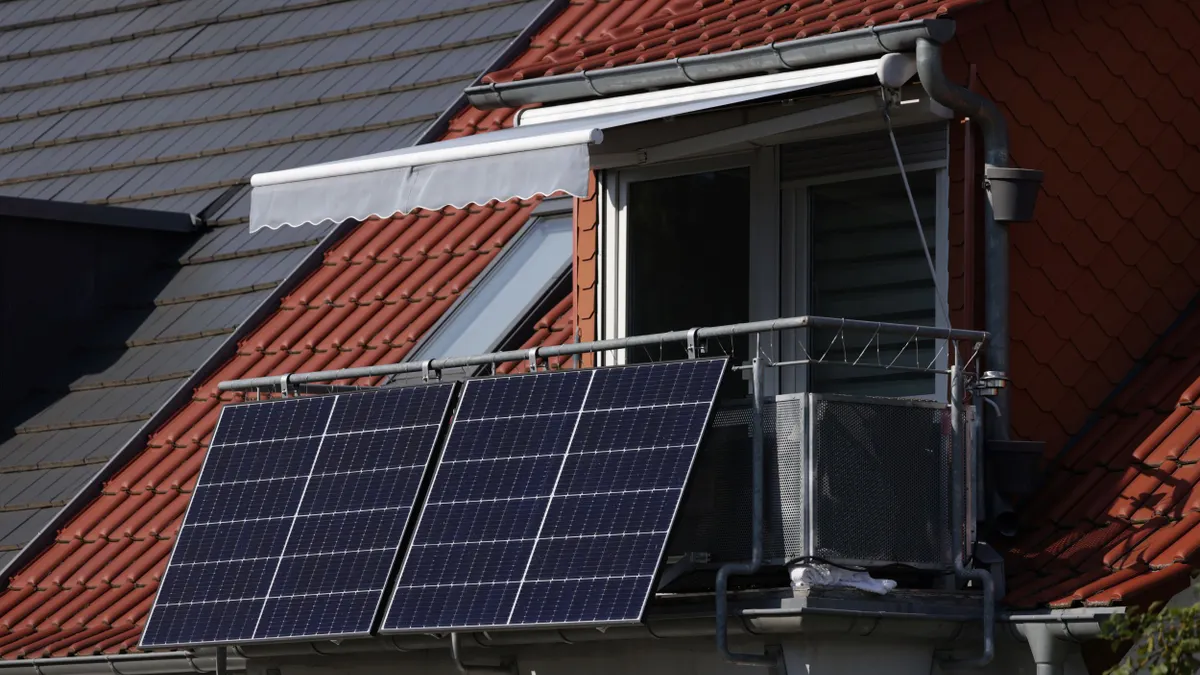
Sunrun, the United States’ largest provider of third-party-owned residential solar and storage systems, said Wednesday that it saw significant declines in subscriber and capacity additions in the second quarter despite a year-over-year increase in battery attachments.
Sunrun’s stock sold off more than 10% after its second-quarter earnings announcement. It recouped some of those initial losses after the Trump administration announced final tariff guidance for imported solar energy components that industry insiders said would create long-term value for the sector.
Sunrun is “scaling deliberately, with a focus on customer experience and asset quality” and “aiming to unlock new ways to monetize the network we've already built, from distributed power plant programs to emerging data center and grid edge applications,” Sunrun CEO Mary Powell said in prepared remarks Wednesday afternoon.
Sunrun has installed more than 4.6 GWh of networked energy storage capacity and attached batteries to nearly three in four of the solar systems it installed in the second quarter, the company said.
Much of that capacity is available to participate in state or regional virtual power plants, such as the Demand Side Grid Support program in California and the ConnectedSolutions program in New England.
A rocky ‘transition’ to direct sales
Despite incremental year-over-year increases in its battery attachment rate and subscriber count, Sunrun cut its full-year 2026 forecasts for cash generation and aggregate subscriber value — two key financial metrics executives have emphasized as indicative of the company’s overall health.
Those revisions came in part from hiccups in the company’s transition from an affiliate-supported sales model to one driven by in-house talent that Powell said would better position Sunrun for the long run.
The April bankruptcy of Freedom Forever, a major Sunrun installation partner, compounded sales volume decreases “due to deliberate reductions we made” in the company’s affiliate channel, Powell said. A longer-than-expected “ramp of sales activities and … process of onboarding new reps” also contributed, she added.
Powell cited incrementally higher interest rates as a separate headwind for the business but noted recent tangible progress in Sunrun’s direct-sales business.
“Our monthly sales trends in our direct business have inflected in June and July, turning positive, with monthly sales growth exceeding 10% compared to the prior year,” she said, predicting a “return to robust growth” in the channel.
A cautious outlook
In a detailed filing Wednesday with the U.S. Securities and Exchange Commission, Sunrun shed additional light on recent headwinds for its principal business, some of which it said could continue to affect its performance in the quarters ahead.
It attributed general “market uncertainty” to a litany of now-familiar factors, including tariffs, global conflict, inflationary pressures, state and federal regulatory changes, supply constraints and elevated interest rates. High interest rates, in particular, “may decrease the amount of capital available to us to finance the deployment of new energy systems,” it said.
The ongoing shift in the U.S. residential distributed energy market from predominantly solar-only to solar-plus-storage — which Sunrun called “the best customer offering” — could itself create challenges for the company, it said in the filing. In California, the largest U.S. residential solar market and one where state incentives heavily favor battery attachments, solar-plus-storage nevertheless “may be more confusing to customers when compared to solar-only offers from competitors” and require longer sales cycles, depressing sales volumes, it said.
Residential solar originations for Sunrun and its competitors in California have yet to regain levels seen prior to the state’s 2023 transition to its present Net Billing Tariff, or NEM 3.0, Sunrun said.
The company’s California business could face further pressure from impending changes to the state’s tax code. Absent action from the state legislature, solar property tax and utility user tax exemptions for residential solar customers are set to expire at the end of 2026, potentially raising costs for Sunrun customers and the company itself, it said.
New diversification opportunities
Amid these and other headwinds — including what the company said in its SEC filing was “increased competition” from new market entrants offering better pricing for customers and installers — Sunrun is increasingly focused on “unlocking value from the customers and assets we already have,” Powell said.
That campaign includes efforts to attach batteries at existing solar-only customers’ homes and expand its long-running virtual power plant business, as well as newer initiatives like a distributed capacity offering and a distributed compute pilot placing high-powered chips in select customers’ homes, Powell said.
In June, Sunrun announced a nonbinding agreement with Renew Home and Tesla Energy to make more than 16 GW of distributed energy resources available to hyperscalers. Those resources are “deployable in months, without the land, transmission, or interconnection burden of traditional generation” for direct energy market participation or offtakers such as utilities, retail electricity providers and large-load customers like hyperscalers, Powell said.
Powell and Sunrun President and Chief Revenue Officer Paul Dickson said the distributed compute pilot was promising but wouldn’t immediately reach commercial scale or generate significant revenue for the company.
“It's hard to say on the commercialization and the revenue opportunity being [2027], whether it would end up being, like, second-half '27 [or] '28, until we complete our pilot,” Powell said.