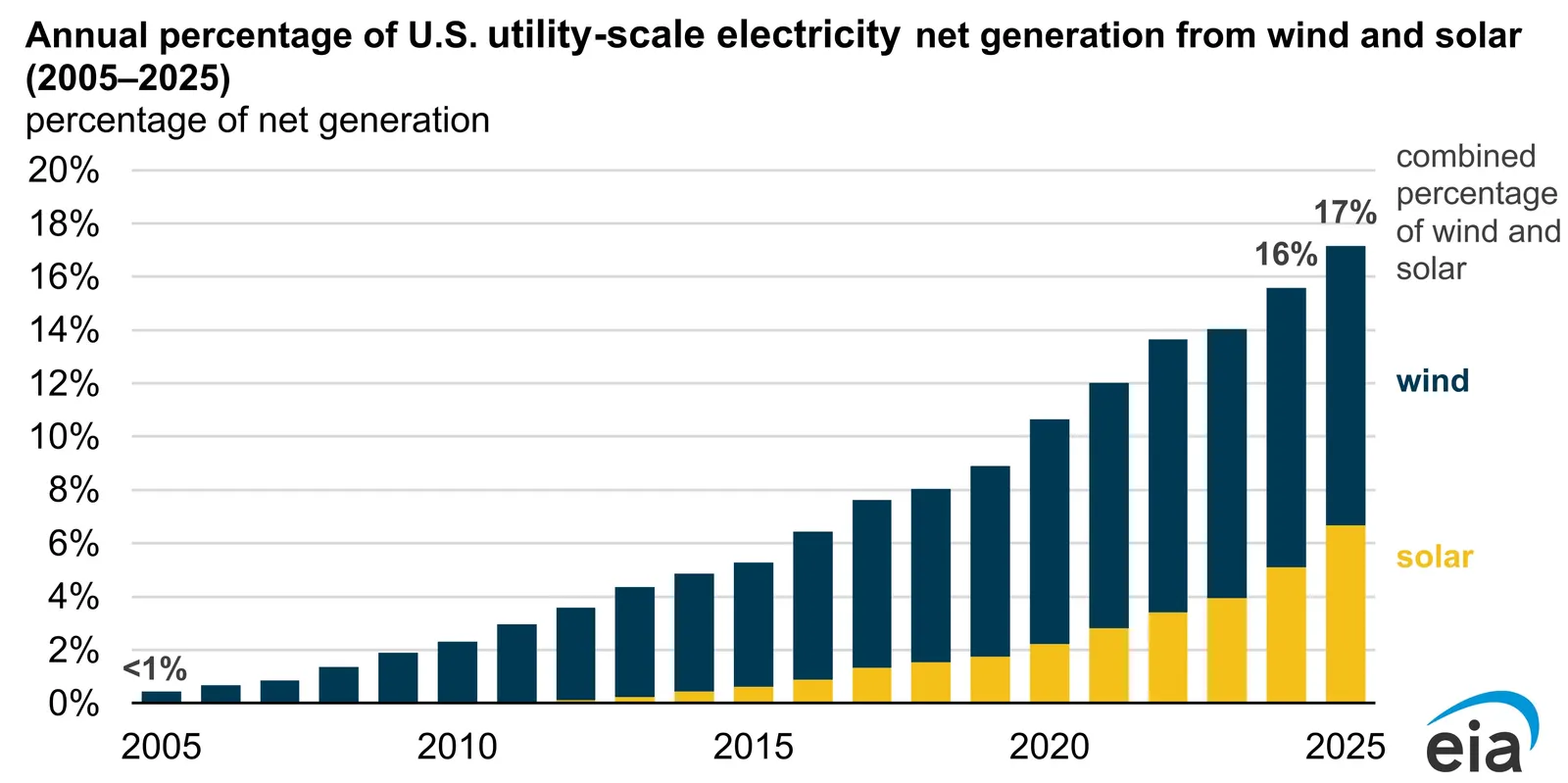
Electricity from utility-scale wind and solar is making up a steadily increasing share of the U.S. generation mix and rose to a cumulative 17% last year, according to a Friday report from the Energy Information Administration.
Though wind generated more electricity in 2025 than utility-scale solar did — 464,000 GWh compared with 296,000 GWh — solar capacity saw the larger increase, rising 34% compared to wind’s 3%, according to the report.
Small-scale solar, which the EIA defines as less than 1 MW, grew to 93,000 GWh last year, up 11% from 2024, the report said. “Combining utility-scale and small-scale solar generation in 2025 increases the share of wind and solar to 19% of total net generation,” EIA said.
Utility-scale solar has grown each year since 2006, EIA said.
A January report from Ember found that the European Union is further ahead on the same trajectory, with wind and solar generating 30% of the EU’s electricity in 2025, surpassing fossil fuel generation at 29%.
In the EU, “wind and solar overtaking fossil fuels in 2025 can be largely attributed to a staggering rise in solar power,” Ember said. “Solar grew by more than a fifth (+20.1%) for the fourth year running.”
EIA expects capacity additions in the U.S. to hit a record high in 2026, with solar assets making up 51% of those additions, according to a Feb. 20 report. Battery storage is expected to make up 28% of new capacity, with 24.3 GW of additions, and wind 14%, with 11.8 GW of additions.
“Developers plan to add 43.4 GW of new utility-scale solar capacity in 2026, a 60% increase in capacity additions from last year if realized,” EIA said.