Dive Brief:
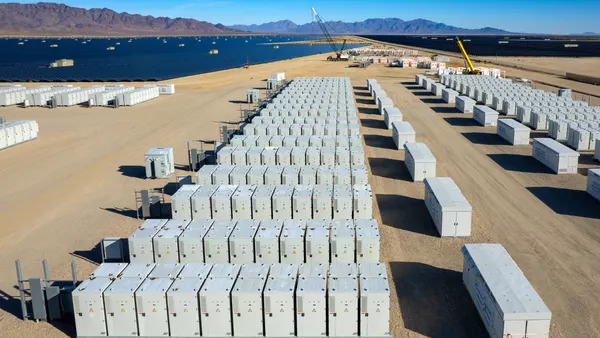
- New York is soliciting bids for up to 1 GW of bulk energy storage and inviting developers to apply for financing from the state’s green bank, the New York State Energy Research and Development Authority said Thursday.
- It’s the second of at least three competitive procurements for large energy storage projects under the most recent iteration of New York’s Energy Storage Roadmap, which aims to add 3 GW of bulk storage and 6 GW of total energy storage by 2030.
- The new procurement comes less than two months after New York announced the awardees for its first bulk storage solicitation, which it held in July 2025. All eight are lithium battery projects, with 950 MW of cumulative power and durations ranging from four to eight hours.
Dive Insight:
Projects the state selects in this latest solicitation will need to meet stringent safety codes the New York State Fire Prevention and Building Code Council adopted in 2025, NYSERDA said Thursday.
Those codes took effect in January after a multiyear rulemaking following a spate of grid battery fires in New York in 2023.
To qualify, projects must have a 5-MW minimum power rating, be able to discharge power into the New York state grid even if not physically located in the state and use an energy storage technology that already has been successfully deployed on the grid, according to NYSERDA’s request for proposals.
The procurement also puts some guardrails around project duration and location. Two-hour resources may account for no more than 10% of the total 3 GW of planned bulk storage procurements, for example.
NYSERDA is targeting durations longer than eight hours for at least 20% of the resources in each procurement, though this month’s RFP suggests that is not a binding requirement if viable longer-duration capacity doesn’t bid into the program.
Seven of the eight awardees in the first procurement were 4-hour projects. The eighth was an 8-hour, 140-MW/1,120-MWh lithium battery installation jointly proposed by Grid Connected Infrastructure and Neoen US in far western New York.
In terms of location, NYSERDA aims to have a minimum of 30% of the 3-GW total bulk storage procurement in the New York Independent System Operator’s Zone J, which covers the five boroughs of New York City. A cumulative 5% minimum target covers NYISO Zones G, H, I and K, covering Long Island and most of the Hudson River Valley south of Albany.
In the first procurement, five of the eight awardees brought a total of 610 MW/2,440 MWh to Zones G, H, I, J or K.
Energy storage deployments in these zones have greater potential to reduce emissions from fossil fuel peaker plants, provide benefits to state-designated disadvantaged communities, or both, NYSERDA said.
One of the agency’s selection criteria is a project’s “ability to address system reliability needs and offset reliance on specific, electrically proximate Peaker generation,” according to the RFP. Another is the potential to reduce curtailment of electrically proximate renewable generation.
Eddie Bautista, executive director of the NYC Environmental Justice Alliance, cheered the procurement’s emphasis on reducing emissions from fossil fuel power plants.
“As New York faces the urgent need to keep our grid more reliable, resilient, and affordable, batteries provide the opportunity to retire and replace dirty and expensive fossil fuel peaker plants for environmental justice communities,” Bautista said in a statement.
Selected projects will have access to two state-backed financial tools to mitigate development risk and reduce revenue uncertainty, according to the RFP.
One is an “index storage credit” paid by NYSERDA and modeled on New York’s renewable energy certificate framework. One ISC is equal to one MWh of daily discharge capability, meaning a 100-MWh battery can create 100 ISCs per day if it remains fully available. An ISC’s value is the difference between an eligible project’s strike price — the approximate revenue threshold for commercial viability — and the approximate wholesale and capacity market revenues the project could earn under normal operations, according to the RFP.
The other is NY Green Bank. The New York Department of Public Service earlier this year ordered the green bank to use 25% of its capital for energy storage financing over the next five years, NYSERDA said. That capital is available for development-stage financing, long-lead equipment financing, construction loans, term loans and more, NYSERDA said.