Dive Brief:
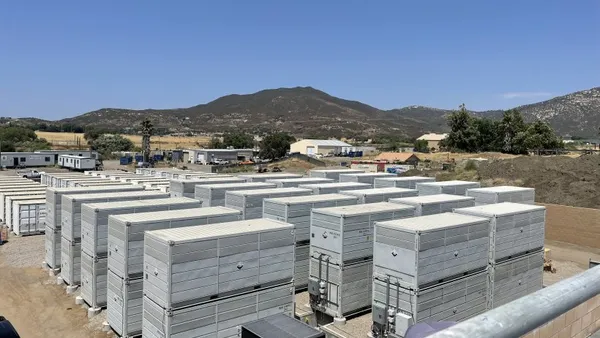
- Energy storage systems supplied 13% to 19% of total generation at capacity factors, on par with gas-fired peaker plants when supply was at its tightest on California’s grid in 2024, avoiding more than $29 million in peak energy costs, RMI said in an analysis released earlier this month.
- The following year, energy storage systems supplied 6% to 9% of generation during the Electric Reliability Council of Texas grid’s tightest hours, RMI said.
- But an ERCOT rule change in December 2025 dampened energy storage systems’ ancillary services participation, adding $3.6 million to ERCOT wholesale pricing over just 24 hours and underscoring batteries’ role in maintaining cost-effective grid stability, RMI said.
Dive Insight:
RMI’s report lands at an uncertain time for the U.S. energy storage industry.
The nonprofit energy think tank’s forecast for 30% annual growth in battery deployment over the next five years is based on a projection made by London-based energy consultancy Wood Mackenzie in 2024, when the Biden-era Inflation Reduction Act was still in full effect.
Earlier this year, Wood Mackenzie dialed back its five-year forecast for utility-scale battery deployments to 16%. Wood Mackenzie’s most recent forecast, released today, sees utility-scale deployment flatlining in 2026 and growing just 8% through 2031. Analysts say President Trump’s August executive order restricting deployment of foreign-produced bulk power components layers new challenges for the industry on top of existing headwinds like import tariffs and unfavorable tax treatment of systems reliant on parts tied to China.
RMI’s report finds already-deployed batteries were helping to stabilize major U.S. grids as far back as 2022. At the peak of a record-breaking heat wave that year, 3.4 GW of grid batteries met 6% of California’s energy needs and “materially strengthened the system’s ability to maintain reserve margins,” RMI said, citing an ICF analysis.
During a less intense heat wave two years earlier, when it had less than 1 GW of grid-connected battery capacity, California saw rolling blackouts despite a demand peak roughly 10% lower, according to the report.
RMI found utility-scale energy storage systems provide significant financial benefits to host communities as well. Its review of project agreements in California, Massachusetts, Nevada and Texas put the average annual gross tax contribution around $6,600/MW, with some contributing more than $10,000/MW.
RMI said a 250 MW/500 MWh battery installation that came online in February will provide about $46 million in revenue over 20 years for the town of Medway, Massachusetts. And even after factoring in partial state property tax abatements, the 400-MW Purple Sage Energy Center will deliver $3.4 million in payments to local governments in Nevada each year, the group said. Libra, another solar-and-storage installation in Nevada, will pay $170 million in property and sales taxes over its lifetime, RMI added.
RMI’s report found significant local health benefits from replacing gas-fired peaker capacity with batteries, too.
RMI used the U.S. Environmental Protection Agency’s CO-Benefits Risk Assessment Health Impacts Screening and Mapping Tool to determine that Suffolk County, New York, could avoid $5.3 million in annual health costs by transitioning its 500-MW Port Jefferson peaker to battery storage. Harris County, Texas, could avoid $3.8 million in annual health costs by swapping its 240-MW La Porte peaker plant for batteries, according to RMI.
Despite high-profile safety incidents like a January 2025 fire that destroyed most of a 300-MW Vistra energy storage array near Santa Cruz, California, serious battery fires are rare and are likely to remain that way now that the more stable lithium-iron-phosphate battery chemistry is the industry norm for stationary storage, RMI said.
The Moss Landing facility used more fire-prone nickel-manganese-cobalt batteries in “an older, noncontainerized design … and a preexisting enclosed space,” RMI said. “Such a configuration would not be permitted under today’s codes and standards.