Dive Brief:
- An additional 1 GW of interregional transmission capability could have saved U.S. consumers $183 million during Winter Storm Fern, Liza Reed, director of climate and energy policy at the Niskanen Center think tank, told the Senate Committee on Energy & Natural Resources Wednesday.
- Some regions saw prices of hundreds of dollars per megawatt-hour during the multi-day storm from Jan. 23 to Feb. 3, while neighboring areas experienced negative power prices. “There was power not being used at all because the transmission was not available to move it to where it was needed,” said Reed.
- Wednesday’s hearing to “examine the state of the bulk power system” focused on regulatory roadblocks to expanding the grid, including transmission, and the need for new technologies and market constructs. U.S. Sen. Alex Padilla, D-Calif., said he and other senators are developing legislation to help modernize transmission development and grow the use of grid enhancing technologies.
Dive Insight:
Electricity bills are up by as much as 13% since President Trump took office, Sen. Martin Heinrich, D-N.M., said in an opening statement, and the administration has threatened 116 GW of new clean energy capacity from coming online.
Transmission investment could address both rising demand and affordability, he said.
“We need to get more out of the grid that we have,” Heinrich said. “Grid enhancing technologies can unlock 20 to 100 GW of additional capacity when demand is highest. These solutions cost less than one quarter of the traditional upgrade costs and can be deployed in three to five years.”
Grid enhancing technology, such as dynamic line ratings and advanced power flow controls, “could reduce grid congestion by 40% or more, saving customers four to $8 billion a year,” he said.
Padilla said his draft legislation builds on the bipartisan Energy Permitting Reform Act of 2024, which passed out of committee but was never voted on by the full Senate.
The new bill will include additions to support implementation of advanced grid upgrades and high-voltage direct current lines, along with improving interconnection procedures and reauthorizing grid resilience grant programs, Padilla said.
“I believe our effort represents not just a common sense plan, but one that will build a cheaper, stronger, more reliable electrical grid that protects ratepayers,” he said.
Other lawmakers involved in drafting the legislation are Sens. John Hickenlooper, D-Colo., Catherine Cortez Masto, D-Nev., Ruben Gallego, D-Ariz., and Angus King, I-Maine.
Sen. Mike Lee, R-Utah, said permitting delays are “slowing projects across all forms of energy infrastructure” while market distortions “are affecting investment decisions, and the pace of innovation in the electricity sector is not where it needs to be.”
“If we modernize permitting, and if we ensure that markets are truly competitive, we can solve this challenge,” Lee said. But if a lack of supply additions hold back demand growth, “the imbalance we're seeing today will become more severe, and the consequences will be felt by American households and businesses.”
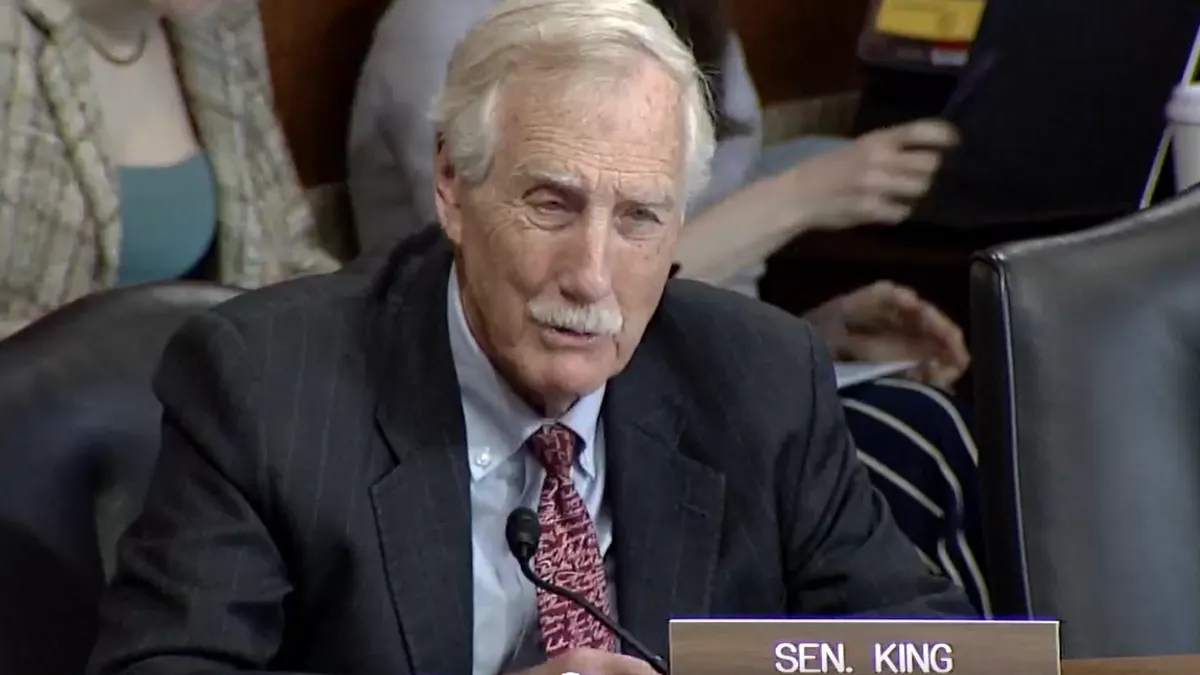
King told the committee that he supports permitting reform efforts but will not participate in discussions “as long as the administration is arbitrarily putting its thumb on the scale and canceling wind and solar projects that, in many cases, have already been permitted. Then, permitting reform only benefits one side of the equation — that's fossil fuel. I'm not going to participate in that discussion.”
“I feel like I'd be dumb to agree to permitting reform which only affected one half of the equation,” King said.
The distribution system is another area where the power sector can get more capacity from existing infrastructure, Heinrich said. The U.S. already has 30 GW to 60 GW of distributed energy resources operating as virtual power plants, he said.
“Deploying another 60 GW could save consumers $20 billion by 2030,” Heinrich said. “But these aren't silver bullet-solutions for long-term growth. We must also build high voltage transmission lines to reduce congestion and reliability risks.”
Transmission congestion cost consumers $12.1 billion in 2024 alone, he noted, but interregional transmission made up only 2% of new circuit miles installed between 2011 and 2023.
NERC in 2024 recommended the addition of 35 GW of U.S. interregional transfer capability, a 40% boost to current capabilities. The U.S. needs “narrow and clear federal authority” to build interregional transmission, Reed said.
Instead, existing market structures create barriers to the deployment of new transmission technologies, Reed said. Grid operators do not compensate high-voltage direct-current transmission technology for some reliability services, she noted.
“China has built tens of thousands of miles of high capacity transmission in the last two decades to our hundreds,” she said. “We are behind on increasing capacity. We are behind on adopting modern technology. And this will put us behind on attracting and maintaining top industries. A shortage of grid capacity is the primary barrier to cost effective and swift deployment of AI in this country.”
In December, BloombergNEF said U.S. data center power demand could reach 106 GW in 2035. By the end of 2025, more than 50 GW of data center capacity was operating in the U.S., representing 24% compound annual growth since 2020, according to the Federal Energy Regulatory Commission.
Todd Snitchler, president and CEO of the Electric Power Supply Association, told lawmakers that one of the greatest risks to reliability and affordability is uncertainty around the demand growth associated with large loads.
“There's a wide disparity about just how much electricity will be needed, when the demand increases will be most prevalent and how quickly the predicted demand will actually materialize,” he said. That introduces the “danger of over- or under-producing capacity during a time of volatile demand projections.”
EPSA supports allowing large demand customers to procure their own new generation “to provide certainty over their supply cost,” Snitchler said. The growing interest in voluntary bilateral partnerships between power plants and large demand customers “embody the competitive characteristics and ratepayer protection that wholesale markets encourage.”
Travis Fisher, director of energy and environmental policy studies at the libertarian Cato Institute think tank, told lawmakers that Congress should enact a policy known as Consumer Regulated Electricity, or CRE, to allow off-grid electric utilities to serve new customers under voluntary contracts.
Those utilities would not be subject to economic regulation at the state or federal level because they do not connect to existing systems or pose a risk to existing customers, he said.
The approach “would enable speed to power for the customers who value it most while not burdening the existing grid,” Fisher said.