Dive Brief:
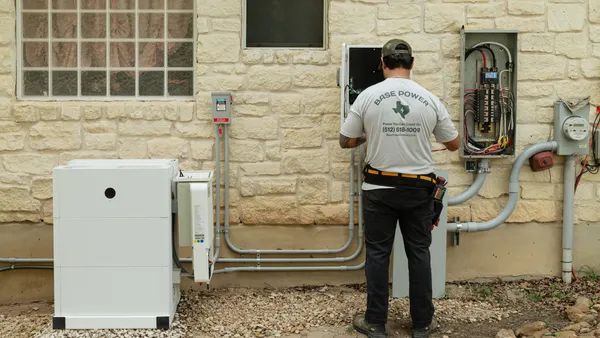
- The U.S. installed a record 18.9 GW/51 GWh of energy storage in 2025, up 52% in GW terms and 40% in GWh terms from 2024, Wood Mackenzie said in its March Energy Storage Monitor. Compared with 2024, residential storage installations jumped 92% in GW terms and 39% in GWh terms as customers raced to qualify for expiring federal tax credits, WoodMac said.
- Meanwhile, U.S. manufacturing capacity for energy storage systems and modules exceeds 100% of expected domestic demand as of year-end 2025, the Energy Storage Coalition said in a separate report. By the end of 2026, domestic manufacturing capacity for battery cells could exceed demand as well, ESC said.
- But WoodMac and some industry experts say uncertainty around federal rules for foreign sourcing of battery inputs and electric load growth forecasts is clouding the medium-term outlook for U.S. energy storage.
Dive Insight:
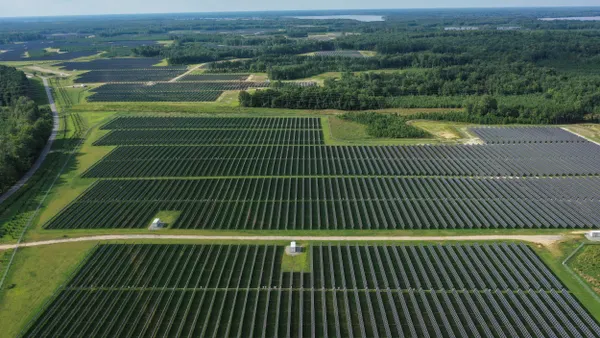
Utility-scale storage remained the largest market segment by far, Wood Mackenzie said. Installations reached 16 GW/47.3 GWh in 2025 for respective increases of 48% and 40% over 2024.
The community, commercial and industrial storage segment, or CCI, saw slower growth than utility-scale or residential, according to WoodMac. CCI installations reached 191 MW/409 MWh in 2025 for respective increases of 16% and 8% from 2024. Policy tailwinds such as California’s Net Billing Tariff, which incentivizes storage attachments on distributed solar PV systems, helped boost the segment in the fourth quarter of 2025, WoodMac said.
CCI installations could decline slightly in 2026 due to commissioning delays for community-scale energy storage projects in Illinois, but the segment is poised to grow 39% between 2025 and 2030, WoodMac said. California, Massachusetts and New York will continue to lead the segment as emerging markets like New Mexico and Connecticut “add diversification,” it added.
WoodMac found the utility-scale market diversifying as well. Despite a 23% increase in battery system pricing from Q4 2024 to Q4 2025, the consultancy said 22 states installed utility-scale storage in 2025 — significantly broadening a market historically dominated by Texas and California.
The long-term extension of the investment tax credit for energy storage systems and expanded domestic cell manufacturing capacity will buoy a project pipeline that reached 682 GW in 2025, up 30% from 2024, WoodMac said. It forecast 16% annual growth in utility-scale installations through 2031 as the U.S. adds around 500 GW of energy storage across all segments.
U.S. energy storage modules and system manufacturing capacity was 69 GWh at the end of 2025 and is set to reach 164 GWh by the end of 2027 as new production facilities come online, according to the Energy Storage Coalition, which forecast 60 GWh in energy storage demand across all segments in 2027.
ESC said domestic battery cell manufacturing capacity is set to exceed expected demand by the end of 2026, as a wave of new production comes online. Cell manufacturing rose from near nothing in 2024 to 20 GWh in 2025 and is expected to hit 96 GWh this year on the way to 133 GWh in 2027, ESC said.
Though those figures comfortably exceed ESC’s estimates for 2027 demand, WoodMac said its later-year forecasts are clouded by continued uncertainty around federal guidance for the Foreign Entity of Concern restrictions outlined in last year’s One Big Beautiful Bill Act. A 52-GW gap separates a “high” forecast encompassing “workable” FEOC guidance and brisk large-load grid additions from a “low” forecast with restrictive FEOC guidance and slower load growth through 2031.
Ravi Manghani, senior director of strategic sourcing at energy intelligence firm Anza Renewables, said in an email that not all incoming domestic supply will meet the FEOC guidelines. He warned of a “near-term disconnect” between headline capacity figures and “usable” supply that could affect energy storage developers’ and utilities’ procurement strategies, project economics and deployment timelines in the coming years.
“Eligibility hinges not just on where systems are assembled, but on upstream component sourcing, intellectual property licenses, and ownership structures tied to FEOC restrictions,” he said. “As a result, a meaningful share of ‘domestic’ supply may not be financeable for projects relying on tax credits.”